

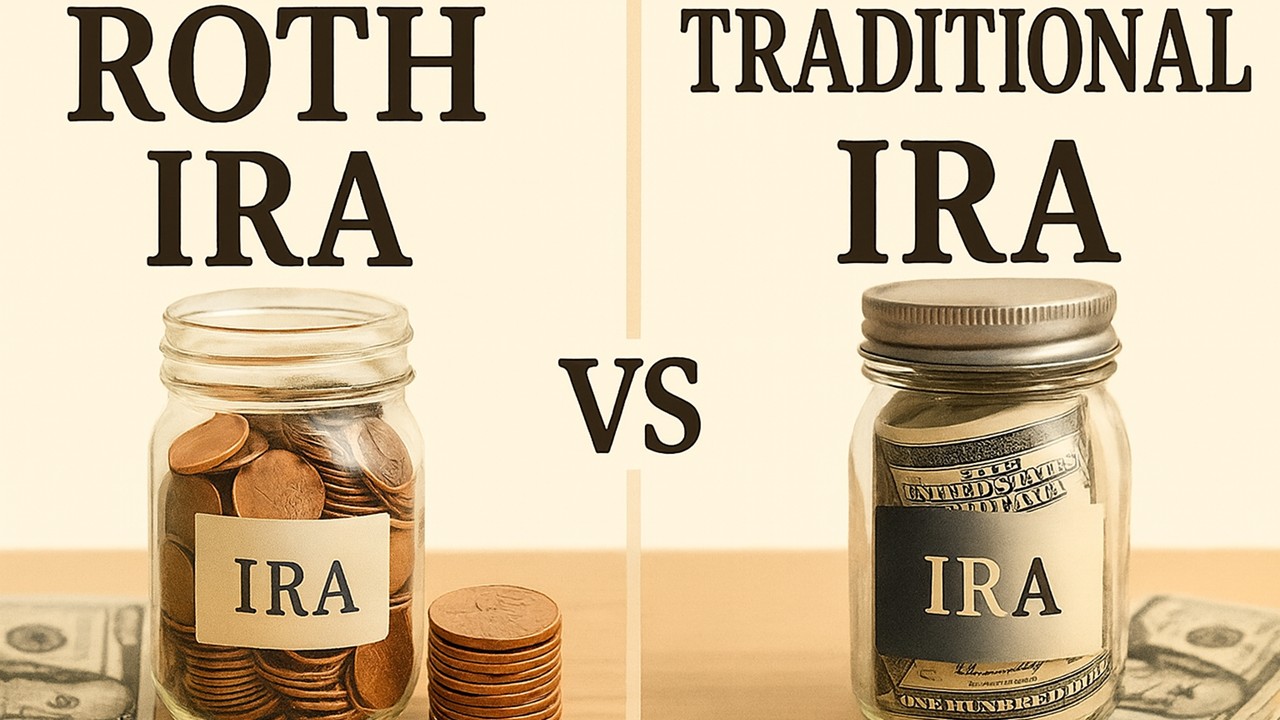
Roth IRA or Traditional IRA—which one should you choose? If these terms feel confusing, you’re not alone. The differences between these two retirement accounts seem complicated, but they’re actually quite simple once you understand the basics.
Today, we’re breaking it down in the simplest way possible so you can feel confident choosing the account that moves you closer to a secure retirement.
Disclaimer: This article is for educational purposes only and not personal financial advice. Everyone’s situation is different, so consult with a professional before making financial decisions.
What Roth and Traditional IRAs Have in Common
First, let’s keep things simple. A Roth IRA and a Traditional IRA are both:
- Retirement accounts designed for long-term savings
- Self-directed – You open them yourself, not through an employer
- Investment vehicles – You choose your own investments inside them
- Tax-advantaged – They both give you tax benefits (just at different times)
- Long-term focused – The money is meant to stay invested until retirement
So what’s the difference? It all comes down to when you pay taxes.
The Core Difference: Pay Tax Now vs Pay Tax Later
Here’s the easiest way to understand the difference between Roth and Traditional IRAs:
Traditional IRA: Pay tax later (tax break now, taxes in retirement)
Roth IRA: Pay tax now (no deduction today, tax-free in retirement)
That’s really the fundamental distinction. Everything else flows from this basic concept.
Traditional IRA Explained
With a Traditional IRA, you’re getting the tax benefit upfront in exchange for paying taxes later when you withdraw the money in retirement.
How a Traditional IRA Works
Tax deduction now: Your contributions may be tax deductible, which lowers your taxable income for the year. However, whether you can deduct depends on your income level and whether you (or your spouse) have access to a workplace retirement plan.
Tax-deferred growth: Your investments grow without being taxed each year. You don’t pay capital gains taxes or taxes on dividends while the money is invested.
Taxed in retirement: When you withdraw money in retirement, you pay ordinary income tax on the entire amount—both your original contributions and all the growth.
Required Minimum Distributions (RMDs): Once you reach age 73 (as of 2024, though this age may change), you must start taking required minimum distributions each year, even if you don’t need the money. This forces you to pay taxes on at least a portion of your account annually.
Simple Summary
Traditional IRA = Save on taxes now. Pay later.
This can be beneficial if you’re in a higher tax bracket today than you expect to be in during retirement.

Roth IRA Explained
With a Roth IRA, you pay taxes upfront but enjoy completely tax-free income in retirement—potentially one of the most powerful wealth-building advantages available.
How a Roth IRA Works
No upfront deduction: You contribute after-tax money, meaning there’s no tax break when you put money in. You pay taxes on this income at your current rate.
Tax-free growth: Your investments grow completely tax-free. No capital gains taxes, no taxes on dividends—ever.
Tax-free withdrawals: In retirement, qualified withdrawals are 100% tax-free. This includes both your contributions and all the growth. That’s potentially decades of investment gains that you never pay taxes on.
No Required Minimum Distributions: Unlike Traditional IRAs, Roth IRAs have no RMDs during your lifetime. This gives you more control and flexibility over your money in retirement.
Early withdrawal flexibility: You can withdraw your contributions (not earnings) at any time without taxes or penalties, though this isn’t recommended for retirement savings.
Simple Summary
Roth IRA = Pay taxes now. Potentially pay nothing later.
This can be extremely beneficial if you’re in a lower tax bracket today or expect to be in a higher bracket in retirement.
Which One Is Better? A Simple Decision Guide
Everyone’s situation is different, but here’s a simple rule of thumb to help you think about it.
Choose a Roth IRA If…
✓ You’re younger or early in your earning years – You have decades for tax-free growth to compound
✓ You expect to earn more later – Your income (and tax bracket) will likely be higher in retirement
✓ You want tax-free retirement income – You like the certainty of knowing withdrawals are tax-free
✓ You value flexibility – No RMDs means you control when and how much to withdraw
✓ You want to leave tax-free money to heirs – Roth IRAs are excellent for estate planning
Choose a Traditional IRA If…
✓ You want a tax break right now – The deduction lowers your current taxable income
✓ You expect lower income in retirement – You’ll likely be in a lower tax bracket when you withdraw
✓ You don’t qualify for Roth due to income limits – High earners are phased out of Roth contributions (though backdoor Roth conversions may be an option)
✓ You prefer reducing taxable income now – The current tax savings help your cash flow today
✓ You already max out your Roth options – You can use both accounts if you want
The Best Answer: It Depends
And here’s an important point: you don’t have to choose forever. Many people use both types of accounts during different seasons of life.
For example, you might contribute to a Traditional IRA during high-earning years (to reduce taxes when your rate is high), then switch to a Roth IRA during lower-earning years or after retirement (when your tax rate is lower).
Contribution Limits and Important Rules
The government sets yearly contribution limits for both Roth and Traditional IRAs, and these limits typically increase over time to keep pace with inflation.
Current Key Points (Rules Change Periodically)
- Both Roth and Traditional IRAs share the same annual contribution limit
- If you’re 50 or older, you can make additional “catch-up” contributions
- Roth IRAs have income limits—high earners may not be eligible to contribute directly
- Traditional IRA deductions may be limited if you (or your spouse) have a workplace retirement plan and your income exceeds certain thresholds
Important: Since these numbers and rules change periodically, always check the most current IRS guidelines or talk with a financial professional before making decisions.
You can find updated contribution limits and income restrictions on the IRS website or by consulting with a tax professional.
Tax Diversification: Using Both
One advanced strategy many financial planners recommend is tax diversification—having money in both pre-tax (Traditional) and after-tax (Roth) retirement accounts.
Why This Matters
By having both types of accounts, you give yourself flexibility in retirement to:
- Control your taxable income each year by choosing which account to withdraw from
- Manage your tax bracket strategically
- Potentially reduce taxes on Social Security benefits
- Create more tax-efficient estate planning strategies
Even if you choose one type now, you might add the other type later as your financial situation evolves.
Which One Wins in the Long Run?
Here’s the surprising math: if your tax rate is exactly the same now and in retirement, a Roth IRA and Traditional IRA produce identical after-tax results.
The real question is: Will your tax rate be higher or lower in retirement?
- If lower → Traditional IRA wins
- If higher → Roth IRA wins
- If the same → They’re equal
Since most people don’t know their future tax rate with certainty, many financial advisors lean toward Roth IRAs for younger people because:
- They have more time for tax-free compounding
- Tax rates could rise in the future
- The flexibility of no RMDs is valuable
- Many people underestimate their retirement income
But this isn’t a one-size-fits-all answer. Your personal situation, goals, and tax strategy should drive your decision.
Final Summary: Keep It Simple
Here’s the simplest way to think about the Roth vs Traditional IRA decision:
Traditional IRA: Tax break now, taxes later
Roth IRA: Taxes now, tax-free later
Both help you build wealth for the future—it just depends on when you want the tax advantage.
The most important decision isn’t whether you choose Roth or Traditional. The most important decision is that you start saving for retirement at all.
A “wrong” choice of IRA type is infinitely better than not saving at all. You can always adjust your strategy as you learn more or as your circumstances change.
Want to learn more? Check out our complete guide on what an IRA is and how it works, or read about how compound interest can grow your retirement savings over time.


